The Traveler’s Guide to Drug Prescriptions and Vaccinations
Trustworthy's Family Operating System® automatically organizes your most important information and turns it into answers, guidance, and action.
Key Takeaways
Travelers must research destination-specific vaccination requirements and recommended immunizations well in advance.
Prescription medications should be kept in original labeled containers and accompanied by copies of prescriptions.
Some medications legal in the U.S. may be restricted or prohibited abroad, making verification essential.
Carrying documentation for medical conditions and maintaining accessible copies of records reduces risk during border checks or emergencies.
Exploring new countries, experiencing different cultures, and trying local cuisines make international travel an adventure.
But to travel safely, you need to be prepared — including when it comes to required vaccinations and managing prescription medications abroad.
Understanding which vaccines are necessary and how to legally carry your medications across borders can help you avoid last-minute complications and ensure a smooth journey.

Bringing Necessary Medications
Some medications may be questioned at customs, so it’s smart to keep them in their original packaging. You should also carry copies of your prescriptions and a doctor’s note explaining why you need them.
Instead of carrying physical copies, which could get lost, store digital versions securely in Trustworthy's Family Operating System® for easy access.
Ensuring Your Prescriptions Are Legal Abroad
Not all medications are legal in every country. Even common prescriptions like ADHD medication, painkillers, or anxiety drugs may be classified as controlled substances in other regions.
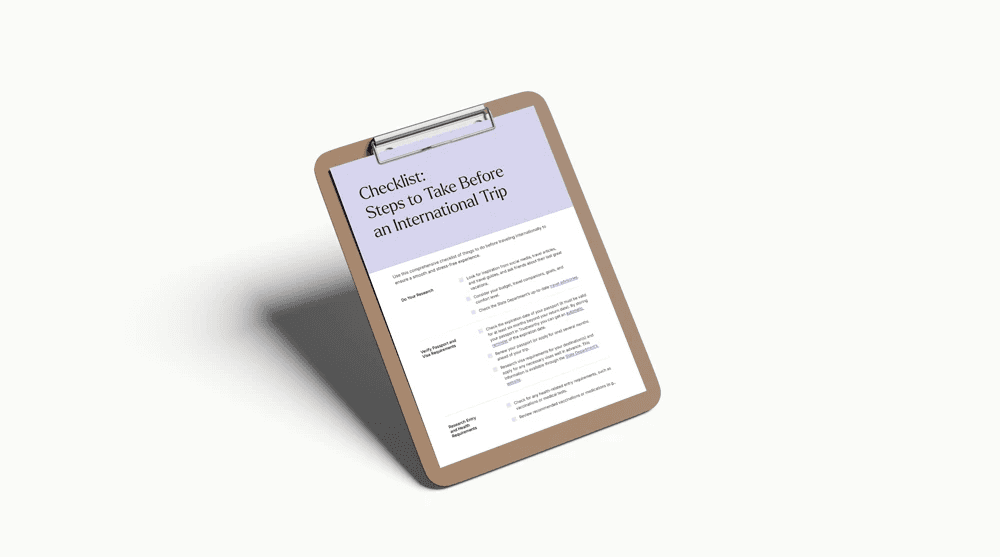
Get Our International Travel Checklist
Use this comprehensive checklist before traveling internationally to ensure a smooth and stress-free experience.
How to check medication legality:
Visit your destination country’s embassy website to review their regulations.
Contact your doctor or pharmacist for guidance on alternative medications.
If necessary, apply for an import permit to bring restricted medications.
Failing to check restrictions could result in your medication being confiscated at customs (or worse, legal consequences). If this happens, you may need to replace your medication quickly.
Be Ready If Something Goes Wrong While You’re Abroad
Store the documents and information you’d need most in a secure place you can access in seconds.
Keeping a copy of your prescriptions and a note from your doctor explaining your condition can help you obtain local replacements more easily. Storing these documents securely in Trustworthy ensures you can access them anytime, anywhere, in case of an emergency.
It’s also a good idea to share information about your medications in advance with a travel partner — through Trustworthy for easy access — in case you have a medical emergency and cannot speak for yourself.
Checking Vaccination Requirements
Some countries require proof of vaccination before entry, while others strongly recommend certain vaccines to protect travelers from region-specific diseases. Checking the requirements well in advance is essential.
How to check required vaccinations:
Visit official sources like the CDC’s Travel Health Notices.
Check the destination country’s government website for entry requirements.
Consult your doctor or a travel clinic to determine recommended vaccines.
Know You Can Reach What Matters — Anywhere You Travel
Keep passports, medical details, insurance information, and travel records organized so you can reach them from anywhere.
Common Travel Vaccinations
Depending on your destination, you may need vaccinations for:
Yellow fever (required for some African and South American countries).
Hepatitis A and B.
Typhoid.
Rabies (for certain high-risk areas).
Japanese encephalitis.
Meningococcal disease (required for the Hajj pilgrimage to Mecca, Saudi Arabia).
Where to Store Your Proof of Vaccinations
Some countries require travelers to carry an International Certificate of Vaccination or Prophylaxis (Yellow Card).
Acceptance of digital versions can vary by country, so it’s best to check your destination country’s regulations. No matter what, store a digital copy in Trustworthy, just in case.
Never Scramble for Travel Information Again
Organize the documents and details you’re asked for most so they’re never buried in email, bags, or memory.
Final Thoughts
When your health documents are organized and accessible, you can travel with confidence, knowing you’re prepared for any situation.
Instead of worrying about misplaced prescriptions or unexpected vaccination requirements, you can focus on the journey itself — exploring new places, experiencing different cultures, and making the most of every moment.
We’d love to hear from you! Feel free to email us with any questions, comments, or suggestions for future article topics.